
Business Pillars Part 2: Clarifying the Plan and Direction
From chaos to focus: building alignment that actually sticks.

Last week, I outlined what I call “Business Pillars,” the five critical elements to any kick-ass, top-notch, dominate-the-competition business. Over the coming weeks, we’ll do a deep dive into each of these pillars. You won’t want to miss it.
This week, we’re diving into the first pillar: defining a clear direction, ensuring your team is heading that way, and maintaining momentum as you move forward.
This principle is ripe with clichés. You’ve likely heard many of them.
My favorite: “If you don’t know where you’re going, any road will get you there.” And boy, is this true. How many businesses right now are frantically heading in ten different directions, trying to be everything to everyone, and falling short of excellence at every turn?
As a leader, you’re responsible not for setting the direction alone, that should be collaborative, in my opinion, but you are responsible for leading the charge in setting that direction. If you don’t, you’ll either be directionless or, even worse, allow outside forces to set your direction, thrusting you into an endless cycle of reacting to the market. It’s exhausting. I know. I’ve tried that method.
Definition of Excellence
For each pillar, we’ll define excellence. This is the standard against which you should evaluate your business.
When it comes to clarity of plan and direction, excellence occurs when the entire team is aware of and living out a shared vision, in their own way, and aligned with their specific roles in the organization.
You’ll know this is happening when there is consistent growth, both company-wide and within individuals, over the last three to five years.
In summary, we all know where we’re going and what we individually need to do to get there.
That is clarity. That is how you head toward the destination with pinpoint accuracy.
So what are the building blocks, the critical elements, of clarifying the plan and direction? There are five.
Element 1: Clarity for the Organization
Begin by defining your organization's core values. These are not aspirational. These are the three to five key traits your best people consistently demonstrate.
Next, your organization must have a clear vision of what it wants to look like in the short and long term. EOS (Traction) defines this as 10 years, 3 years, one year, and 90 days.
What metrics are you attempting to hit in those timeframes? What type of team is needed to get you there? What goals and initiatives must be accomplished to achieve this vision?
Who is your customer? What is your strategy for reaching them? What problem in the market do you solve? How will your team be supported in carrying out these initiatives?
Answering these questions initially and revisiting them regularly is how you create organizational clarity.
Element 2: Clarity for the Individual
Once your organization is clear on its direction, each individual must determine their role in the journey. What unique skills and abilities do they bring to the table that will help accomplish the goals? How can their passions and skills align with their day-to-day responsibilities?
People flourish when they know they are a critical part of a winning team. It’s up to the leader to help coach them toward a clear definition of what this looks like for them as individuals.
Sometimes this clarity means people discovering that they’re in the wrong seat on the bus. Perhaps this is an opportunity to change seats. Perhaps it means it’s time to get on a different bus. Either way, the individual, and thus the organization, is better for it.
Element 3: A Consistent Cadence
Setting direction is not a one-and-done process. Why? Because things change. People change. Market conditions change. Growth brings change.
Excellence in this pillar requires regularly revisiting the plan, not necessarily to change it, but to ensure we don’t lose sight of our north star.
Many believe 90 days is about as long as an organization can go without drift. I agree. I find that the week or so before our quarterly planning meeting, I start to feel an itch. I’m ready to reconnect and realign with my team.
Element 4: Accountability
Creating a plan for the team and defining the roles we’ll play is a waste of effort if the team is not held accountable to the mission and to each other.
And this isn’t a boss-getting-on-your-case type of thing. Nope.
Great organizations self-regulate.
What does this look like?
It means there is such a high level of buy-in among team members that someone deviating is quickly noticed and brought back into the fold. This is the definition of great culture.
Element 5: Agility
A great plan and direction have flexibility built in, allowing quick response.
Wait. What? I thought you just said the whole reason for having a plan is to avoid reacting?
In my view, this is the difference between the micro and the macro.
The macro does not change very often: core values, target market, purpose, niche, and your 10-year, 3-year, and one-year plans. Changing those requires an act of Congress.
But the micro, the “how are we going to do this in the next 90 days,” is your opportunity to be agile, to iterate, and to be flexible. Is it possible to know precisely what each quarter will look like as you walk toward your 10-year plan? Nope. And that’s why you, as a leader, must be highly in tune with the market, your customer, and your team to know how to lead.
Some quarters are about growth. Others are about restructuring. Occasionally, others are about resting. That’s the organic nature of a small or mid-sized business. A clear plan and process allow for these modifications along the way.
Tools and Inspiration
So, what tools are available to support this pillar? Two come to mind.
The first is EOS (Traction). EOS is an operating system for your business. We’ve been running it since 2017 at kitchen & bath CRATE and since the beginning at Trinity Builder Solutions. I also use it for my personal brand and, in a modified form, in my personal life. It’s an excellent system that any business or organization should consider.
The second is Kim Scott’s Radical Candor approach. The book is a great place to start, but it’s much more than that. I find it to be the best approach to ensuring your team is supported in both personal and professional growth.
Wrap Up
Being part of an organization with clarity of direction is refreshing. When you’re confident everyone knows where you’re going and is excited to chip in to get there, it’s a feeling like no other. And really, it’s the true definition of leadership.
The next pillar we’ll cover is “Designing the Customer Experience.” This is all about creating a remarkable process to wow your customers. And trust me, this applies to both business-to-business and business-to-consumer.
If you’d like to get this upcoming series directly in your inbox, please go ahead and subscribe. And of course, if you know someone who may benefit from this information, please share this email with them.
I appreciate you following along on this journey. As always, let me know if I can help in any way: scott@scottmonday.com.
Thanks for reading this post. I appreciate you.

Free Guide: 🧠 Build Your 2026 Business Plan Using AI
I just released my full framework for building a 2026 Playbook: a simple, AI-assisted process to help you plan the year ahead in hours, not days.
If you lead a business or team, this is the exact tool I use every October to clarify goals, align strategy, and make next year’s planning effortless.
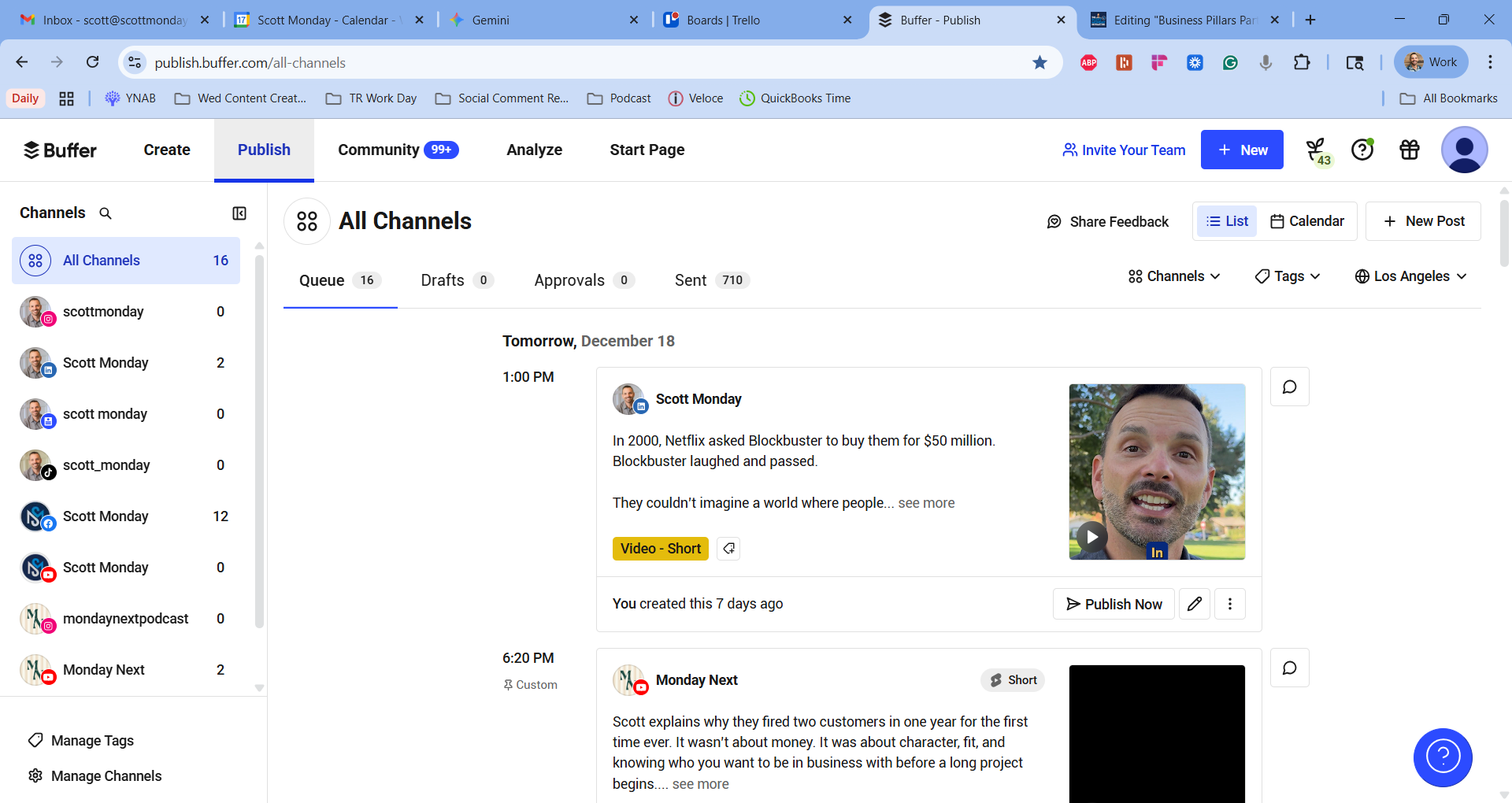
Things I've Enjoyed Lately: I’ve been using the social media posting software Buffer for almost a year, and I love it. It makes it easy to generate content and schedule posts. It also has a really cool Kanban-style planning board that lets you track content ideas and move each piece through the production process. It’s a game-changer.