
How to Generate Cash
Growth is eating your cash. Here's how to fight back.

Nothing freezes a business operator’s blood quite like the idea of running out of cash.
Insufficient funds for payroll or critical accounts payable (A/P) coming due make an entrepreneur feel vulnerable, embarrassed, and at times downright terrified.
I mean, can you imagine 10, 100, or 1,000 eyes on you when you reveal paychecks won’t be forthcoming? Ugh. It’s the stuff of nightmares.
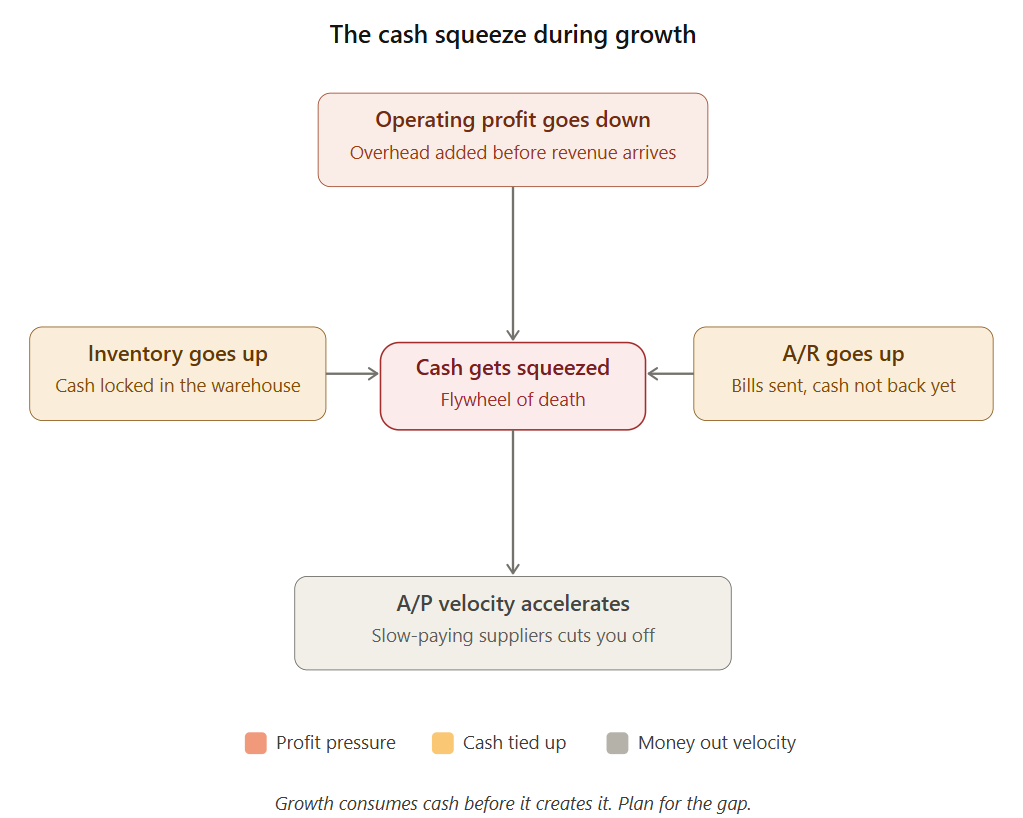
Last week I covered four “Cashflow Forces” that affect available funds, specifically when a company is in the midst of growth. Growth puts a unique and substantial strain on cash, and it’s often during growth that companies are in the most danger of “growing out of business.” Here’s a quick refresher on how growth adversely impacts cash reserves:
During times of growth:
Operating profit goes down - Growth often requires adding overhead (people, equipment, vehicles, software) prior to the expected increase in revenue. This tanks your net profit. And net profit is the cash you need to fund growth. It’s a flywheel of death!
Inventory goes up - Not only do you need to “pre-buy” overhead, but you often need to secure added inventory in anticipation of growth. And all that inventory might as well be suitcases of cash sitting on the warehouse floor.
Accounts receivable (A/R) goes up - As you grow, you send more bills. As you wait for those bills to be paid, your A/R goes up. A/R is almost entirely cash you’ve deployed but haven’t gotten back from your customers. (You’re the “other people’s money.”)
Accounts payable (A/P) likely stays similar - The money you owe others will likely increase in total, but you won’t be able to slow-pay very much. Otherwise, your suppliers and vendors get nervous and cut you off. So the “money out velocity” will certainly accelerate.
OK, this is all well and good. But how do we battle these forces? Here’s what to do:---
Operating Profit Goes Down -> Increase Profit Percentage PRIOR to Growth
I talk about this idea of “Profit Islands” quite a bit. Every business has certain revenue milestones that allow for maximum profitability. It’s completely unique to each business. Almost like a “profit DNA.”
So, what you want to do is drive your profit percentage up to its maximum level BEFORE starting your growth push. It’s like storing up food for winter.
For example, if your business is normally at a 10% net profit margin, but can get to 15% when running “lean and mean” (even if it’s painful and everyone is stretched and stressed), you want to do that before commencing your growth phase.
This gives you some cushion during growth. You’ll see your 15% come down, perhaps even below your 10% average net profit. But it’s better to go from 15% to 5% than from 10% to 0%. (Remember, at 0% you’re actually losing cash due to debt service and other “at the bottom of the P&L” line items.)
Inventory Goes Up -> Focus on Rapid Inventory Turn
The best operators focus on turning inventory as quickly as possible. The moment it comes in, it’s properly accounted for and deployed into the market. Sloppy inventory management is like a leaky faucet. It may not seem like much, but over time, it can cause major damage.
It may seem obvious, but timing your inventory purchase as close as possible to when you need it is the single best thing you can do to reduce cash tied up in inventory. This can be tricky, of course. The last thing you want is to need inventory to fulfill an obligation and not have it on hand.
That said, this is probably the least-preventable of the four Cashflow Forces. Just do your best.
Accounts receivable (A/R) Goes Up -> Negotiate Hard
You know the real estate adage, “you make money when you buy, not when you sell?”
Well, the business corollary is “you preserve cash when you negotiate a contract, not when your invoices are due.” Sounds rather inelegant, doesn’t it? I need to work on that...
Still, it’s true. So it’s critical to be diligent when negotiating the terms of your contracts. Ask, ask, ask for quicker payment terms, every time, without exception.
I’ve found the most effective way to secure better terms is to propose alternative language directly.
So instead of just saying, “the payment terms are too long,” say “In section 7, paragraph 2, the contract mentions payment terms of [insert terms]. Can we revise this section to instead say [insert your preferred terms].”
This allows the negotiator on the other side to simply give a quick “sure” and paste your language right into the revised contract. Play to the desire people have to quickly and easily resolve issues. You might be shocked how often your proposals are accepted.
And of course, once your invoices are approaching their due dates, it’s time to start hounding. Many companies subscribe to the policy of not paying A/P until someone asks for it. It’s their way of preserving cash. So be the one to ask, early and often. Every day you get paid sooner is a day that helps prop up your cash position.
Accounts Payable (A/P) Likely Stays Similar -> Negotiate Hard
Just like your contracts with customers, your agreements with suppliers are completely negotiable. So, once again, ask, ask, ask for longer terms. Your ideal scenario is that your customers are on terms half as long as your suppliers.
For example, our commercial subcontracting business seeks 30-45 day terms with clients and 60-90 day terms with suppliers. While this doesn’t fully bridge the cash flow issues when it comes to payroll and most overhead, it at least helps.
Remember, your suppliers are hungry for your business. And if they’re large companies, they likely have the cash position to work with you on terms. They’d rather give you net 90 than see your business go to a competitor. Be unabashed about pitting suppliers against each other. Mention competitors often in your negotiations. It makes a difference.
And of course, if needed, delay payment to suppliers.
Wrap Up
Managing cash flow is easily a top-5 topic when I chat with other operators. I’m often shocked by how many companies are living on the “cashflow edge.” And I’ll admit, I’ve been there many times myself, especially in times of growth.
Like most things, having a plan and hitting the issue head-on is the best way to go.
Roll out the tools above, and over time, you’ll likely be less cash-poor than you did before.
Need to riff a bit about navigating cashflow issues? I’d love to help. scott@scottmonday.com
My sister and I launched a podcast for sub-$20M business owners and operators. Episode 10, the season finale, is out!

We’d be honored if you’d give it a listen! You can find it on Apple Podcasts, Spotify, or whatever platform you prefer!

Things I've Enjoyed Lately: Financial literacy is a skill set with significant impact on our lives. As the father of teens and young adults, I do my best to arm my kids with the tools they’ll need to properly manage their personal finances. A book I’d highly recommend, to this end, is Scott Galloway’s The Algebra of Wealth. It’s one of the better ones I’ve read in terms of foundational personal finance knowledge.